
February 3, 2026
When to Replace vs. Repair a Retaining Wall in Northern Michigan
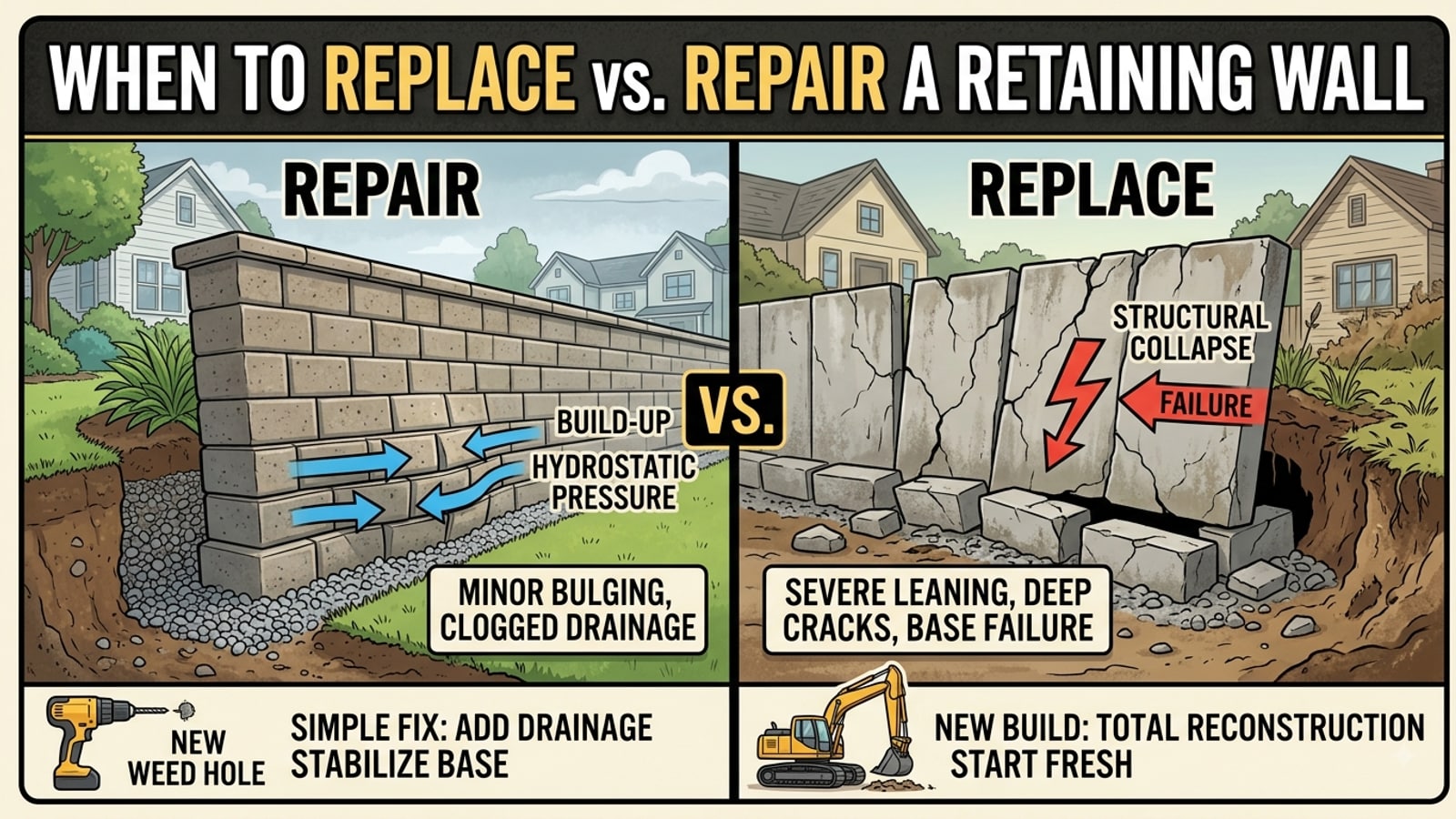
We get a version of this call every spring, right after the frost comes out of the ground: “My retaining wall is leaning — can you fix it, or do I need a whole new wall?” It’s a fair question, and the honest answer is that it depends on what’s actually wrong underneath, not just what you can see from the yard.
The symptoms that usually mean “repair”
If a wall has a single bulging or leaning section but the rest of the wall is straight and tight, and the problem hasn’t gotten noticeably worse over the past year or two, there’s a decent chance we’re looking at a localized issue — often a section where the original drainage or backfill wasn’t done correctly, while the rest of the wall was built properly. In these cases, we can sometimes excavate just the affected section, correct the drainage and backfill, and reset the blocks without touching the rest of the wall.
Minor cosmetic issues — a few cracked cap stones, some settling at one corner, small gaps between blocks — also usually fall into repair territory. These don’t indicate the wall is failing structurally; they’re wear and tear that can be addressed without a full rebuild.
The symptoms that mean “replace”
Widespread leaning or bulging across most of the wall’s length is a different story. If the whole wall is pushing outward, that’s almost always a sign the entire wall was built without adequate drainage or without geogrid reinforcement where it was needed — meaning the same problem exists behind every section, not just the one that’s currently the most visible. Patching one spot on a wall like this just means you’ll be back out here in two years dealing with the next section.
Other signs that point to a full rebuild: visible separation between the wall and the soil behind it (a gap opening up at the top, sometimes with soil or mulch spilling through), significant vertical cracking through multiple blocks, or a wall that’s noticeably worse than it was even a single winter ago. Rapid deterioration usually means water is actively working against the wall right now, and that’s not something that stabilizes on its own.
Why drainage is the deciding factor either way
Whether we’re repairing a section or rebuilding the whole wall, the fix is the same underlying principle: get water out from behind the wall before it can freeze and push. That means a perforated drain tile at the base of the wall, wrapped in clear stone backfill that lets water move to the drain instead of pooling against the block. Almost every wall failure we’ve diagnosed in fourteen years around Petoskey, Charlevoix, and Boyne City traces back to this being missing or undersized — not the block system itself, and not usually a lack of geogrid.
What a wall inspection actually involves
When we come out to look at a wall, we’re checking a few specific things: how much of the wall’s length is affected, whether there’s a visible gap forming behind the top course, how the wall has changed over time if you have old photos, and — when we can get access — what’s actually going on with drainage behind it. That last part sometimes means a small exploratory dig, which tells us more than a visual inspection ever could.
A rebuilt wall, done right, is a decades-long fix
The frustrating part of this conversation is that a wall failure is almost always preventable — it’s a drainage detail that either got done right the first time or didn’t. When we rebuild a wall, we’re not just resetting the same blocks; we’re correcting whatever let water get trapped in the first place. That’s the difference between a wall that needs this conversation again in five years and one that doesn’t need it again in your lifetime.
If you’re not sure which category your wall falls into, that’s exactly what a site visit is for — there’s no charge to come take a look and tell you honestly what we’re seeing.
Interested in Retaining Walls?
Engineered segmental retaining walls that hold back slopes and handle our frost-heave-prone soils.
Learn more about Retaining Walls →