
March 10, 2026
Paver Patio vs. Poured Concrete: What's Right for Your Northern Michigan Home?
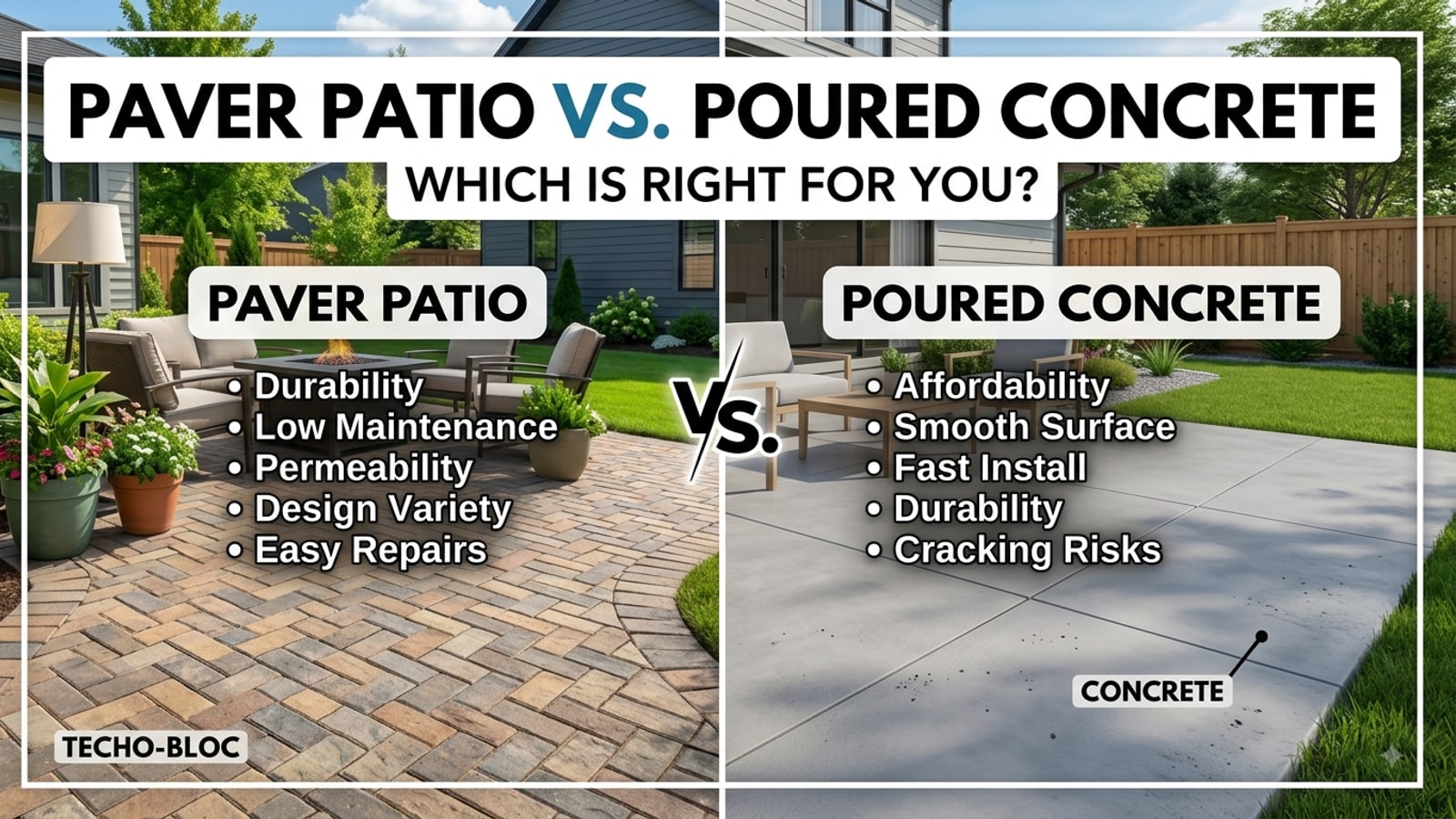
This is one of the first questions almost every homeowner asks us during a patio consultation, and it deserves an honest answer rather than a sales pitch — because there are situations where poured concrete is a perfectly reasonable choice. Here’s how the two actually compare once you factor in a real northern Michigan winter.
Upfront cost
Poured concrete is usually cheaper per square foot upfront — often by a meaningful margin on a large patio. If budget is the primary constraint and the design is simple (no curves, no built-in features), concrete can make sense purely on first cost. Pavers cost more upfront because of the labor-intensive base preparation and the individual unit installation, but that upfront cost is doing real work, which brings us to the part that matters most in our climate.
Freeze-thaw durability
This is where the comparison gets lopsided fast. A poured concrete slab is a single rigid sheet. When the ground beneath it heaves unevenly — which it will, given a hundred-plus freeze-thaw cycles a year — the slab has no way to accommodate that movement except by cracking. Once a crack forms, water gets into it, freezes, and widens it every winter after. We’ve seen concrete patios crack within two or three winters when the base wasn’t built to handle our frost depth, and once concrete cracks, there’s no clean fix — you’re looking at a visible patch or a full replacement.
A paver patio is fundamentally different: it’s thousands of small, independent units sitting on a flexible base. When the ground shifts slightly, individual pavers can move slightly with it instead of cracking. That flexibility is the whole reason pavers hold up better here over the long run — not because the material itself is stronger, but because the system is designed to move instead of fight the ground.
Repairability
If a paver settles or a single unit cracks from, say, a dropped grill or a heavy planter, we can pull that one paver, fix the base underneath it, and reset it — usually in under an hour, with no visible seam once it’s done. If a section of concrete cracks or settles, your options are a visible patch that will never quite match the original color and texture, or breaking out and repouring the whole section, which is disruptive and expensive. Pavers age more gracefully because problems stay local instead of becoming a whole-slab issue.
Design flexibility
Pavers come in enough colors, patterns, and shapes that we can match a patio to your home’s exterior, build in curves, and mix in accent bands or borders without much added complexity. Concrete can be stamped or colored to mimic some of this, but the finish is applied to the surface rather than being part of the material — and in our climate, stamped and colored concrete finishes are especially prone to surface scaling from de-icing salt exposure over time.
Where concrete still makes sense
If you’re working with a tight budget, want a simple rectangular slab, and are comfortable with a shorter expected lifespan and less design flexibility, concrete isn’t a bad choice — it’s just a different set of tradeoffs. We’d rather tell you that honestly than talk everyone into pavers regardless of the project.
Our honest recommendation
For most of the outdoor living projects we build around Petoskey, Harbor Springs, and Charlevoix — spaces meant to be a long-term investment in a home, often used for entertaining and built to complement a nicer piece of property — pavers are the better long-term value once you account for freeze-thaw durability and the real cost of concrete repairs down the line. But the right answer genuinely depends on your budget, your design goals, and how long you’re planning to be in the home. We’ll walk through all of it honestly during your design consultation.
Interested in Paver Patios?
Custom-designed paver patios built on a compacted base engineered for northern Michigan's freeze-thaw cycles.
Learn more about Paver Patios →